Upcoming · Microsoft Build 2026 · Fort Mason Center, San Francisco · 2 June 2026 · 6 min read · By DBI Analytics
Microsoft Build 2026 puts AI agents, Fabric MCP, Microsoft IQ, and enterprise AI workflows in the spotlight. But without governed domain knowledge, Agentic BI becomes a risk. Here is why ABIS acts as the gatekeeper.
As Microsoft Build 2026 opens at Fort Mason Center in San Francisco, one message is becoming impossible to ignore: AI agents are moving from demos into enterprise workflows. Fabric Data Agents are generally available, the Fabric MCP Server is the standard interface between AI and governed data, and Microsoft Agent 365 is the enterprise control plane. The headline announcement that ties it all together is Microsoft IQ — a unified enterprise intelligence framework with three pillars: Web IQ (real-time external grounding), Work IQ (workplace and collaboration intelligence via Microsoft 365), and Fabric IQ (data and analytical ontology). Fabric IQ is the layer that directly competes with what ABIS has been building.
The platform is ready. The question is whether the enterprise is.
This article explores what Microsoft Build 2026 confirms about Agentic BI, what Microsoft IQ and Fabric IQ mean for AI agents in Business Intelligence, and why local-first domain knowledge governance — not cloud storage — is the missing layer that DACH enterprises must address before AI agents start acting on their data.
01 — From dashboards we read to agents that act
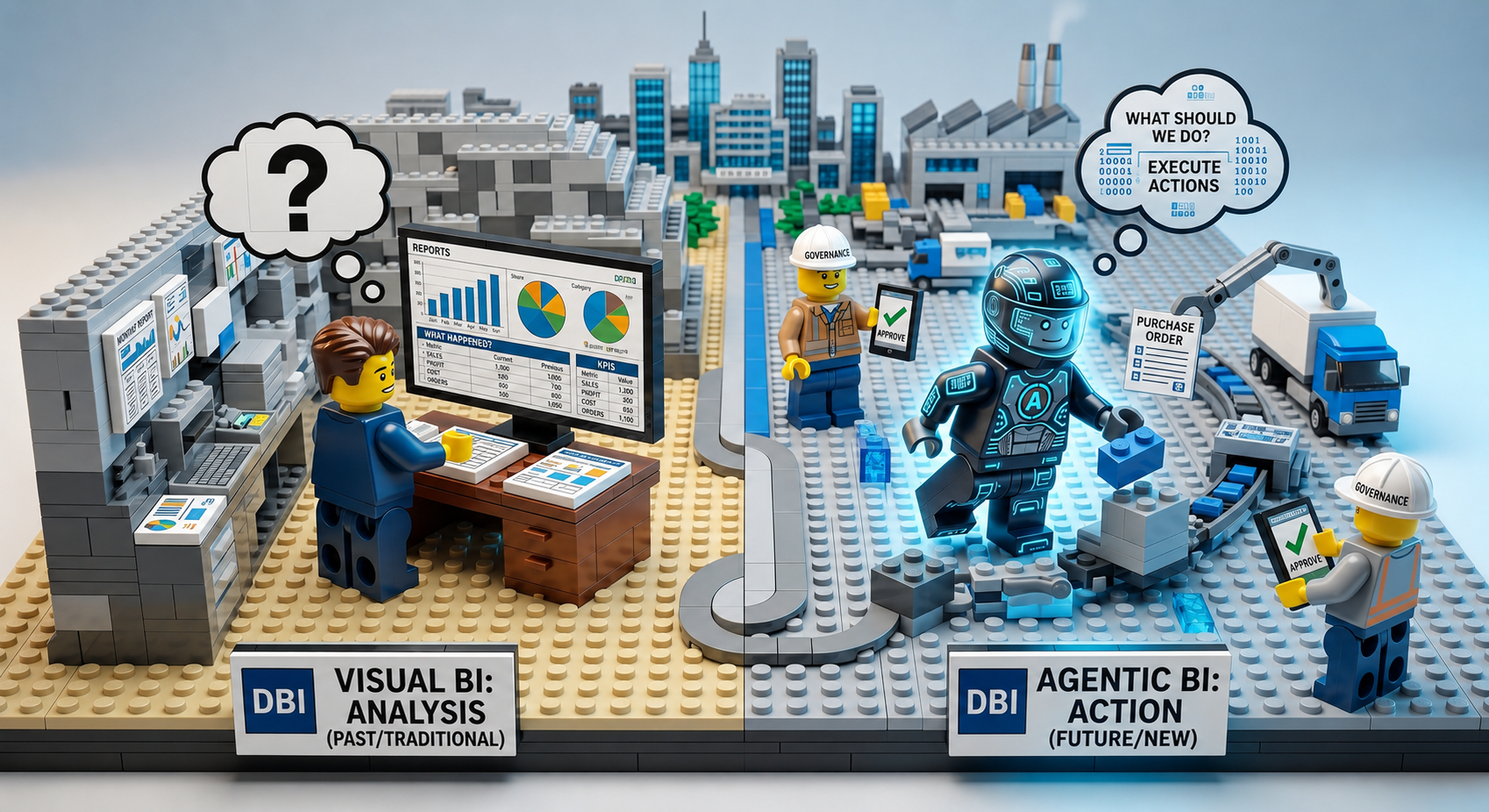
For two decades, Business Intelligence has been a reading exercise. We built dashboards. Someone opened them. Someone interpreted them. Someone made a decision. The dashboard was never the point — the decision was. We just didn't have a better way to bridge the gap between data and action.
Agentic BI changes that bridge.
The idea is simple: AI agents sit inside the analytics process — not on top of a dashboard waiting to be read, but inside the workflow, running analyses autonomously when the user asks for them. The dashboard becomes one of several outputs the agent can produce, alongside a written analysis, a notification, or a triggered action in another system.
This is not speculation. It has been validated at the platform level by Microsoft in recent months, and it is the throughline of every keynote at today's Microsoft Build 2026 in San Francisco.
02 — What FabCon and Microsoft Build 2026 confirm about AI agents
At FabCon 2026 in March, Microsoft moved Fabric Data Agents into general availability. The agents act as virtual analysts: they explore data, identify anomalies, and generate insights without manual instruction. At the same event, Microsoft announced the Fabric MCP Server — a standardized interface that lets any AI system, not just Microsoft's own, interact with Fabric data through natural language while respecting governance policies.
At Microsoft Build 2026 in San Francisco, the throughline is the same: agents in production — and now underpinned by a unified intelligence architecture.
| Announcement | Event | Status |
|---|
| Fabric Data Agents | FabCon March 2026 | Generally available |
| Fabric MCP Server | FabCon March 2026 | Generally available |
| Purview DSPM for AI | FabCon March 2026 | Generally available |
| Microsoft Agent 365 (enterprise control plane) | GA 1 May 2026 | Generally available |
| Azure Agent Mesh (federated agent execution) | Build 2026 | Preview · GA Q4 2026 |
| Microsoft IQ (Web IQ · Work IQ · Fabric IQ) | Build 2026 | Announced |
| Dedicated Responsible AI track | Build 2026 | First time at Build |
The conclusion is clear: Microsoft is investing at platform scale in exactly the future ABIS has been describing. That is good news.
But it also makes the next question urgent.
03 — Microsoft IQ and Fabric IQ: what Microsoft Build just revealed
Microsoft IQ is the most significant architectural announcement at Build 2026. It is Microsoft's attempt to build the unified "brain" that sits across all cloud and data platforms — turning fragmented corporate information into a live, semantic graph that both humans and AI agents can understand.
The framework has three pillars:
Web IQ acts as a real-time grounding layer. Instead of relying on static model weights, Web IQ gives agents a direct pipeline to live public web data — market trends, regulatory updates, shipping disruptions — and lets them fact-check internal conclusions against external sources.
Work IQ sits on top of Microsoft 365 and connects AI agents to unstructured workplace data (Teams chats, emails, SharePoint documents via Microsoft Graph) and structured business records (Dynamics 365 via Microsoft Dataverse). It calculates organizational meta-context — project velocity, team collaboration patterns, workflow urgency — and exposes ten generic MCP-based APIs so agents can act directly inside productivity workflows.
Fabric IQ is the layer that matters most for BI. It sits closest to the data infrastructure and transforms raw, disparate enterprise data into a structured corporate ontology. It defines core business concepts — Entity Types like Warehouse, Products, Customers, Shipments — and the semantic relationships between them. It binds those entities to both historical data in a Lakehouse and real-time streaming data in an Event House. The explicit ontology gives LLMs a logical roadmap and is designed to prevent hallucinations.
That last part is important. Fabric IQ is doing what ABIS does: building a semantic layer on top of enterprise data so that AI agents reason correctly about business context. It is the most direct competitive signal Microsoft has ever sent to the governed BI market.
The difference lies in where that semantic layer lives — and who controls it.
04 — The new central question: who can act?
"For two decades, governance was about who can see what. When agents act on the data, the question becomes who can act on it — and that is a different control problem."
Permissions models, row-level security, sensitivity labels — all built around the assumption that a human being would see information and decide what to do with it.
When an agent sits in the middle of that loop, the question changes:
It is no longer just who can see this number?
It is who can act on this number?
And: which agent, on whose authority, with what audit trail?
This is a harder control problem. It is also where most enterprise AI strategies will quietly fail in the next two years.
05 — Microsoft Purview, Fabric IQ, and the governance gap
Microsoft has built impressive answers here. Purview's Data Map traces lineage across Azure, Power BI, and Synapse — and, through Apache Atlas hooks and REST APIs, into third-party systems. The Purview Data Catalog provides a shareable governance layer. DSPM for AI surfaces sensitive data risks in AI prompts and responses. The Fabric MCP Server opens this governed environment to any conforming agent. And now Fabric IQ adds a semantic ontology layer that makes agent reasoning over Fabric data far more reliable.
It is a comprehensive, cloud-native intelligence suite. For organizations whose data already lives in Microsoft's cloud, it is a strong answer.
The architectural reality
But Microsoft IQ — and specifically Fabric IQ — is, by design, cloud-first. The semantic ontologies, entity graphs, and agent reasoning logs that Fabric IQ generates live in Microsoft's tenant, not yours. Even when Purview scans on-premise data sources, it does so through a self-hosted integration runtime that extracts metadata and ships it to the Microsoft Purview Data Map in the cloud. The intelligence layer — the catalog, the lineage, the ontologies, the rules — belongs to Microsoft's infrastructure.
Microsoft's own documentation acknowledges this: Power BI Copilot does not yet support sovereign clouds due to GPU availability constraints. DSGVO-sensitive workloads require careful planning around where data physically lives and where metadata travels.
ABIS vs Microsoft Fabric IQ — feature comparison
| Capability | Microsoft Fabric IQ / Purview | ABIS |
|---|
| Semantic ontology / entity graph | Fabric IQ Entity Types and Relationships — defined in Fabric, stored in Microsoft's cloud tenant | Lineage knowledge graph across the full toolchain — Power BI, Fabric, SAP, DATEV, LucaNet — not anchored to one vendor |
| Lineage knowledge graph | Data Map (Apache Atlas) with Microsoft-stack connectors + third-party via REST API | Lineage graph across the full toolchain — cross-vendor |
| Rule & governance layer | Purview Catalog, Policies, DSPM for AI — comprehensive | Configurable rule layer shareable within the team's perimeter |
| Team sharing | Cloud-resident policies shared via Purview | Governance rules shared inside the organization's own perimeter |
| On-premise / local knowledge | ⚠️ On-premise scanning still ships metadata and ontology to the cloud catalog | ✅ Desktop app keeps governance knowledge on the user's machine |
| Sovereign cloud / DSGVO | ⚠️ Not yet supported for Copilot; metadata and entity graphs leave the tenant | ✅ Local-first by design — data stays in the tenant |
| Domain knowledge protection | ⚠️ Fabric IQ ontology stored in Microsoft cloud; business meaning travels outside the perimeter | ✅ Protects company-specific business logic and definitions locally |
| Vendor dependency | Deep Microsoft ecosystem integration — Fabric IQ requires Fabric-native data architecture | Cross-vendor, works alongside Microsoft stack |
This is not a criticism of Microsoft. It is a description of an architectural reality. Cloud-first platforms — including Fabric IQ — have cloud-first trade-offs.
06 — What ABIS does differently
ABIS was built for the segment where those trade-offs are deal-breakers. The architecture has three layers:
Layer 1 — Lineage knowledge graph with connectors
ABIS maintains its own lineage graph that connects across the toolchain — Power BI, Fabric, SAP, DATEV, LucaNet, and the dozens of other systems that show up in a real DACH enterprise. The graph is not anchored to a single vendor's platform, which means it works where the enterprise actually is, not where it ideally should be.
Layer 2 — Rule and governance layer, team-shareable
On top of the graph sits a configurable rule and governance layer. Teams define their own policies — who can act on which data, under which conditions, with which audit requirements — and share those policies internally without exposing the underlying data to external systems.
Layer 3 — Knowledge on the employee's machine, on-premise
This is the structural difference. The ABIS desktop app keeps the governance knowledge — the rules, the lineage, the agent reasoning — on the user's local machine. Data, metadata, and agent decisions stay inside the organization's perimeter by default.
For regulated industries, that is not a feature. It is the only viable architecture.
07 — The real bottleneck: domain knowledge
The next BI advantage will not come from storing more data in the cloud. It will come from protecting the meaning of that data.
This is the part many AI strategies still underestimate.
Most companies do not fail because they lack data. They fail because their most important knowledge is not stored in a clean, holistic, machine-readable structure.
- Power BI measures
- Naming conventions
- Old Excel logic
- SAP extracts
- Controller assumptions
- Undocumented business rules
- The head of the person who has "always known how this number is calculated"
Cloud platforms — including Fabric IQ — can build semantic ontologies for the data they can see. They can catalog metadata and expose agents to governed workspaces.
But they do not understand the full local business context behind the numbers. They do not know which Excel-based margin calculation overrides the SAP standard. They do not know which Power BI measure was deprecated but is still referenced in three dashboards. They do not know what "revenue" means in the context of the Q3 planning cycle versus the statutory close.
That is where ABIS becomes the gatekeeper.
ABIS is not just another analytics layer. It protects the company's domain knowledge before an AI agent is allowed to reason, answer, or act. It connects lineage, rules, semantic context, ownership, business definitions, and local governance into one controlled structure.
Without that gatekeeper, an agent may answer fast — but with the wrong definition of revenue, margin, forecast, customer, or risk.
And that is more dangerous than a slow dashboard.
Because when AI gets enterprise context wrong, it does not look wrong. It looks confident.
08 — Why local knowledge matters more than cloud storage
The future of BI is not simply cloud vs. on-premise.
Where does the knowledge live that tells the AI what the data actually means?
Fabric IQ answers that question inside the Microsoft tenant. It is a genuine semantic layer — better than raw Purview catalogs — but it is still a cloud-resident answer. If that knowledge is fragmented, undocumented, or only partially represented there, then the agent is operating on an incomplete map. It may see tables, columns, lineage, and entity definitions — but it still misses the business logic that makes the answer trustworthy.
For DACH enterprises, this is critical.
Local domain knowledge is often the real intellectual property:
- How KPIs are defined
- Which reports are trusted
- Which measures are deprecated
- Which business rules override standard logic
- Which systems are authoritative
- Which exceptions matter in practice
ABIS protects this knowledge locally and structurally.
It becomes the control layer between the enterprise and the agentic AI wave — including Microsoft IQ.
Not because Microsoft is wrong. Because Microsoft is building the platform.
ABIS protects the company-specific context that makes the platform safe to use.
No LLM compensates for missing data quality. No agent compensates for missing governance. And no cloud ontology — not even Fabric IQ — replaces the local domain knowledge that actually explains the business.
Microsoft Build 2026 and FabCon confirm the direction: agents are moving into production. Fabric Data Agents are generally available, the Fabric MCP Server connects AI to governed data, and Microsoft IQ — with Web IQ, Work IQ, and Fabric IQ — is Microsoft's new unified intelligence architecture.
That validates the ABIS thesis.
But it also makes the risk clearer.
The companies that win with Agentic BI will not be the ones that connect an LLM to the most data first. They will be the ones that control the meaning of their data before agents start acting on it.
The right answer by segment
| Segment | Right answer |
|---|
| Cloud-native organizations | Microsoft Purview + Fabric IQ + Agent 365 + Microsoft IQ |
| Regulated DACH — BaFin, Solvency II, GxP, BNetzA | Local-first domain knowledge governance — ABIS |
| DACH Mittelstand with SAP / DATEV / LucaNet / Power BI estates | ABIS as gatekeeper for business context and agentic BI governance |
The agentic future is here.
The missing layer is not just data governance.
It is protected domain knowledge.
That is what ABIS is built for.
Frequently asked questions
What is Agentic BI?
Agentic BI is the next stage of Business Intelligence where AI agents sit inside the analytics process and autonomously run analyses, generate insights, and trigger actions on behalf of the user — rather than waiting for a human to read a dashboard and decide. Microsoft validated this direction at FabCon 2026 with the general availability of Fabric Data Agents.
What did Microsoft announce at Build 2026 about AI agents?
Microsoft Build 2026 in San Francisco builds on FabCon's earlier announcements and adds a new unified intelligence architecture: Fabric Data Agents in general availability, the Fabric MCP Server as a standardized AI-to-data interface, Purview DSPM for AI, Microsoft Agent 365 as the enterprise control plane (GA 1 May 2026), the new Azure Agent Mesh for federated agent execution, Microsoft IQ (Web IQ, Work IQ, Fabric IQ), and a first-time dedicated Responsible AI track.
What is Microsoft IQ?
Microsoft IQ is the unified enterprise intelligence framework announced at Microsoft Build 2026. It is designed to act as the overarching "brain" across Microsoft's cloud and data platforms — turning corporate information into a live, semantic graph that both humans and AI agents can understand. It has three pillars: Web IQ (real-time external grounding via live web data), Work IQ (workplace intelligence across Microsoft 365, Teams, and Dataverse), and Fabric IQ (data and analytical ontology over enterprise data in Fabric).
What is Fabric IQ and why does it matter for BI governance?
Fabric IQ is the data and analytical intelligence layer within Microsoft IQ. It transforms raw enterprise data into a structured corporate ontology by defining Entity Types (such as Customers, Products, Warehouses) and the semantic relationships between them. It binds those entities to both historical data in a Lakehouse and real-time streams in an Event House. For BI governance, Fabric IQ is significant because it performs semantic structuring of data — the same fundamental task that ABIS performs — but as a cloud-native, Microsoft-tenant-resident service. Organizations with strict data residency or sovereignty requirements need to evaluate whether their semantic knowledge layer can sit in Microsoft's cloud or must remain on-premise.
What is the Fabric MCP Server?
The Fabric MCP Server is Microsoft's implementation of the Model Context Protocol for Microsoft Fabric. It provides a standardized interface that lets any AI agent — Microsoft's own or third-party — discover datasets, understand semantic models, and execute queries against Fabric data while respecting governance policies. It was announced at FabCon 2026.
How is ABIS different from Microsoft Fabric IQ?
Both ABIS and Fabric IQ build a semantic layer over enterprise data so that AI agents reason correctly about business context. The key architectural difference is where that layer lives. Fabric IQ is cloud-native: the entity graph, ontologies, and semantic mappings are stored in Microsoft's cloud tenant. ABIS keeps the lineage graph, governance rules, and domain knowledge on the user's local machine — a local-first architecture designed for DSGVO-regulated DACH industries where data and metadata cannot leave the tenant. ABIS is also cross-vendor: it covers SAP, DATEV, LucaNet, and Power BI in a single graph rather than requiring a Fabric-native data architecture.
Why does local-first data governance matter for DACH enterprises?
Regulated industries in DACH — banking under BaFin, insurance under Solvency II, pharma under GxP, utilities under BNetzA — face hard data residency requirements that cloud-first governance platforms cannot always satisfy. Schrems II added further legal pressure on US-cloud-resident metadata. Local-first governance is not a preference for these industries; it is often the only viable architecture.
What is a domain knowledge graph?
A domain knowledge graph captures not just data lineage but the business meaning behind the data — how KPIs are defined, which measures are authoritative, which exceptions apply, and which business rules override standard logic. This company-specific context is the real intellectual property that determines whether an AI agent's answer is trustworthy.
About ABIS
ABIS is DBI Analytics' agentic BI governance platform. It provides a lineage knowledge graph with connectors across the enterprise toolchain, a team-shareable rule and governance layer, and a local-first desktop deployment model designed for DSGVO-regulated environments. ABIS acts as the gatekeeper between company-specific BI logic and the agentic AI wave.
→ Talk to us about ABIS
Contextual Intelligence for AI? What really matters is your knowledge protect it!
DBI Analytics GmbH · Your partner in data excellence · dbi-analytics.de · Blog